Surface Power Diagrams for Knit Singularity Placement

Rahul Mitra*, Mattéo Couplet*, Ruichen Liu, Jonathan Ng, Ruza Markov, Will Samosir, Megan Hofmann, Edward Chien
Boston University, VARIANT3D, Northeastern University
SIGGRAPH, 2026

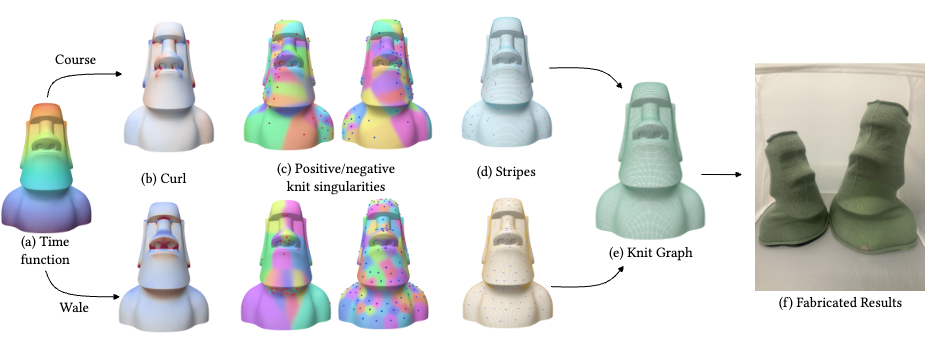
Overview of our pipeline. (a) A knitting time function informs the direction of knitting. (b) A course and wale curl signal is computed from the normalized gradient of the time function. (c) Our method solves a semidiscrete optimal transport problem, represented by geodesic power diagrams, for both the positive and negative parts of the curl signal. (d) The centers of the cells inform placement of left/right short row ends for the courses and increases/decreases for the wales. (d) Using these singularities, a pair of orthogonal stripe patterns are computed for the course and wale directions, which are then (e) intersected to produce a helix-free knit graph. (f) Fabricated results of the Moai statue at two different knit graph resolutions dressed on 3D prints. The visualized graph corresponds to the larger knit.

Abstract

We present an algorithm for global knit structure planning that leverages a generalization of power diagrams to triangulated surfaces. This generalization is based on modified geodesic heat kernels and is used to quantize the curl measure of a normalized knitting time function gradient. Knit singularity positions are optimized jointly in a global fashion via an iterative Lloyd-type algorithm, leading to faster and more optimal placement of singularities than prior work, allowing for practical creation of denser knit graphs. In this denser setting, we present singularity ordering constraints that more robustly achieve helix-free knit graphs. The speed and robustness of the method is demonstrated via a diverse array of knits, and a virtual gallery of helix-free knit graphs. We also provide further demonstration of user constraints for knit singularity masking, level set alignment constraints, and apparent seam placement via curl boosting.

BibTeX

Coming soon!